Overlay
Let's talk

Hello!

How Do You Get Your Team Excited About an Uncertain Future?

How Do You Get Your Team Excited About an Uncertain Future?

The old axiom about uncertainty being the only certainty in business seems quaint given today’s headlines: Historically low unemployment. Hiring shortages one day and hiring freezes the next. Creeping inflation. Unexpected layoffs. It’s whiplash inducing. And it’s the world we live in.

As the economy shifts and shudders, leaders are challenged to make strategic decisions with increasingly limited foresight. And employees? They’re left feeling disoriented, confused, and vulnerable. It’s a recipe for getting stuck. People become less willing to make mistakes, to stick their necks out for each other, or to take the smart risks necessary to adapt to the changing environment. In a time when flexibility and agility are critical qualities to success, many organizations find themselves in a state of emotional contraction, unable to zag gracefully forward. 

The problem is alignment. Conventional objective-setting tools simply fall short as a way to get everyone on the same page because they’re based on past assumptions rather than the competing signals of the future. Plus, they don’t give employees the right context for seeing themselves in that changing future—much less get them excited about it.

At Emotive, we believe that companies need more responsive tools to adapt to the future—whatever it holds. They need ways to connect to what employees are feeling. And they need to equip their organizations not with a best guess about the future, but rather with a clear picture of how they’ll create their future. When employees feel they have the agency and ability to control their destiny, they lean into the future with an entirely different spirit. 

When you understand the emotional state of your organization, you can move forward. Faster.

How do your employees feel? Are they cynical or optimistic? Are they barely hanging on or feeling enthused and inspired? Do they understand the vision for where the company is going? Or do they need more evidence and explanation?

The more understood and recognized people feel in times of uncertainty, the more opportunities you have to deepen trust and allegiance. If you ask, people will let you know how aligned they are with a vision for the future and the strategy to get there. You can identify what dissonances need to be reconciled. Where the sources of doubt take hold. What fears need to be assuaged before they grow out of proportion. Powerful alignment—the kind required to change and adapt with the business environment—is only possible if you have clear insight into the emotional state of your organization at any given moment.

We use the lens of brand to audit the emotional state of an organization and identify alignment opportunities that can reduce friction, create efficiency, and drive growth. Our approach recognizes that businesses are more than just a collection of employees working towards a common goal. They’re complex networks of people with myriad emotions, attitudes, and beliefs. When you actually know what’s animating people’s behavior—the critical emotional drivers—you can craft more resonant, engaging stories about what you’re all working toward. 

Emotional understanding only makes a difference if your growth story is clear.

While emotional understanding can improve conventional objective-setting by creating deeper connections with people, you still need to establish a clear point of view that will guide your organization toward its future.

All businesses have multiple critical initiatives going on at any given moment. If the narrative about how they connect is haphazard or unintentional—or confused by external market conditions—people will start quilting their own narratives. The result is multiple, often conflicting stories that lead to different end states. In other words, brand confusion. 

We’ve created a wonderfully simple approach to helping businesses fulfill their ambitions. When clients need to realize important outcomes, we work side-by-side with executive leaders to co-author a strategic narrative of how—and why—they want to grow. We call this a Growth Manifesto, and it serves as a powerful tool for cutting through the noise of function-specific goals, objectives, KPIs, and OKRs to make business and brand more emotionally relevant to the people in an organization. It connects major initiatives—corporate strategy, product, go-to-market, brand, people & culture—in a single, coherent narrative that aligns everyone behind the promise of the brand and the actions required to support it.

Your growth story can’t be separated from the quality of storytelling.

In times of flux, business leaders face pressure to leap into action—to batten down the hatches, set a course, and prepare teams to brace for the worst. But what employees most need today is leadership that inspires people with purpose and meaning amidst uncertainty. If your organization is feeling trapped by mounting performance pressure and shrinking time horizons, you must give every employee the ability to see, believe, and participate in creating a future that they know is not only possible but necessary. Emotion is the accelerant, the enabler, the multiplier, and the amplifier that connects powerful ideas more deeply and resonantly to the people who need them.

To grow in times of uncertainty, you need to understand how your people are feeling. You need to address their emotions with a story of how you plan to grow. And you need to get them focused on a future that they are empowered to create. This is how you translate all the ambition that underpins your brand into a coherent set of actions that keep an organization aligned, confident, and positive as it speeds into the uncertain future.


Brand Salience Is the Lifeline Between You and Your Customers

How Are Purchase Decisions Actually Made?

Let’s say you need to buy a toilet brush. You’re at the store with your partner, and they say, “The brushes are just down that aisle, do you mind grabbing one?” Suddenly, you find yourself in front of a wall of toilet brushes. Never in your life have you actively thought about toilet brushes, toilet brush brands, or the state of the toilet brush market. But now, somehow, you find yourself in the position of trying to form an emotional connection to an object that arguably has the worst job in your house. Do you grab the cheapest one? Or maybe just the one you recognize?

The Magic of Brand Salience

Enter brand salience, the unsung hero of indecisive buyers everywhere. In cognitive psychology, “salience” refers to what is most prominent or noticeable. The term describes how “our attention is drawn to intense stimuli such as bright lights, loud noises, saturated colors, and rapid motion.” For marketers, salience is the degree to which your brand is thought about or noticed when a customer is in a buying situation.

Not to be confused with top-of-mind awareness, which is simply the link to the name of the product category and depends on a single, specific cue. Salience extends far beyond brand awareness. It’s the probability of a person noticing, recognizing, and thinking about your brand when it matters most.

Emotion-led Decision Making

Why is this important? Because as much as we’d like to believe that people make purchase decisions based on rational, utility-maximizing thought, we don’t. According to a study by Kantar, one of the world’s largest insight and consultancy groups, “Consumers rely on mental shortcuts or heuristics when they make their brand decisions. One such heuristic is to assign greater importance to things that have ready mental availability, the effect of which is to choose the most salient brand.”

All this to say we’re flawed, tenderhearted creatures making most choices based on feeling, experience, or precedent. Jenni Romaniuk and Byron Sharp of the Ehrenberg-Bass Institute for Marketing Science have done research into brand salience, and they’ve found that it’s largely a function of the quantity and quality of the consumers’ memory structures.

Quantity of Memory Structures

In buying situations, consumers are often driven by mental cues that trigger their thoughts around brand consideration sets. For example, if I’m thinking about finding affordable healthcare coverage that allows me to thrive, I’m likely to consider Kaiser Permanente. Since 2004, their ubiquitous “Thrive” campaign has been a staple across TV, radio, online, print, and outdoor platforms in markets throughout the country. The more memory structures your brand is linked to, the more salient your brand, the more likely it is to be thought of during a buying situation.

Unfortunately, what people remember about brands isn’t always the same across buying decisions. Even if you’ve seen the same ads as me, you might have a completely different association to the word “Thrive.” Quantity alone isn’t enough.

Quality of Memory Structures

Romaniuk and Sharp argue that the quality of brand salience is a function of the strength of the association and the attribute relevance. As a former resident of Oakland where Kaiser is based, I’ve seen countless “Thrive” executions, so the linkage is very strong. Additionally, if affordability is important and relevant to me because I’m on a budget, this further increases brand salience.

The quality of brand salience speaks to that classic ad adage: “When I needed a mattress, I saw mattress ads everywhere. Then after I bought one, they all disappeared.” Your need and desire instruct what you see in the world. What you don’t need becomes invisible. At the end of the day, brand salience is a function of a) the quantity of memory structures your brand is linked to; b) the quality of these structures, as defined by the strength of association and relevance of the structure. Your job as a brand is to stay permanently visible by being exactly what your customer needs, right when they need it.

How Do You Increase Brand Salience?

Increasing brand salience is a real estate battle for taking up the most space in your customers’ heads and hearts. Brands can build their brand salience by developing a number of different memory links in buyers’ minds. This can be done a myriad of ways, whether through differentiation, storytelling, or creating meaning. Whatever you implement, maintaining customer share-of-mind depends on consistent and quality advertising. Deployment of the same distinctive assets is what will help your brand win in the marketplace over time. Here are three actionable measures your brand can take to increase its brand salience.

  1. Lead with emotion to create distinctive, memorable assets. Could you pick your content out of a crowd? Is your design unmistakably yours? How can you make your look and feel unforgettable?
  2. Take a bold risk to get noticed. When we talk about memory, we’re talking about that special signal that cuts through the noise. Who do you remember from the last party you attended? Was it the person quietly minding their own business in the corner? Probably not.
  3. Go out of your way to continuously reach potential buyers. There are new ways to form memory structures with your target audience every day. Whether it’s podcasts, newsletters, or mixed reality brand experiences, every leap in technology is another tool to build a new emotional connection.

The Best Thing To Be Is Remembered

Byron Sharp, author of “How Brands Grow: What Marketers Don’t Know,” says that the pursuit of differentiation and segmentation is not as useful as “creating memorable and consistent brand assets that trigger an instinctive response when they’re seen or heard at critical purchase moments – in other words, they should focus on brand salience.”

There are so many things to consider when building your brand. Of course, brand salience is not the only factor, especially in B2B situations where the journey to purchase is much more complicated than a single point of sale. Regardless, if you can create memorable and distinctive brand assets that trigger an instinctive response in a purchasing situation, you’ve already won.

Emotive Brand is a brand strategy and design agency in San Francisco.

Want to Grow Your Business? Adopt a Founders’ Mentality

Growth Paradox

We work with CEOs every day, developing strategy and helping leaders position their businesses to meet their growth goals. From small, young start-ups, to well-established, huge enterprise businesses, CEOs have a tough role – and leading business forward amidst high growth is a challenge we see again and again.

Today’s companies are scaling faster than ever before – even in the middle of increased competition, market pressures, and the stress of solving problems faster and faster. It’s no surprise that the average lifecycle of organizations is getting shorter and shorter.

The paradox of growth is a problem that plagues many of our clients. Companies start experiencing growth and greater success in the market, but with this initial high-growth comes complexity. And eventually, this complexity stunts growth. CEOs come to us feeling disconnected from a clear purpose with a slow, fuzzy vision of how to proceed.

Changing Mindsets: A Founders’ Mentality

In high-growth periods, it’s a challenge to continue to establish credibility, build trust, live the brand’s values, rally employees, satisfy customers, and act as the head decision maker and strategic lead.

We’ve found adopting a founders’ mentality – thinking, acting, and leading like you founded the company – can ensure you grow business sustainably and successfully. Here’s what leading like a founder looks like:

1. See Beyond Today

Founders of companies are excited by the future, and driven by it. They aren’t just thinking about today, but years down the road. And for any CEO today, long-term thinking is critical to successful growth. Your vision for the future should define and guide how you grow today, tomorrow, and for years down the line. Re-evaluate and ask yourself where you see the company in one year, 3 years, 5 years, even 10 years. Get clear about your growth goals and how they align to your business and brand goals. Your job is to evaluate the whole picture and lead from there.

2. Obsess Over Customer Satisfaction

Think about a founder’s first customers. That founder works tirelessly to create the best experiences and foster the most meaningful relationships with those customers – because they are key to the businesses’ success moving forward. Every customer should be approached with this kind of intent. As businesses grow their customer bases, it’s easy to lose sight of customer satisfaction. But it still matters – and arguably, even more. Your customers have the chance to be your biggest advocates or your largest hurdles. Obsess over their experiences, and grow a brand that people will continue to love.

3. Foster Loyal and Energized Employees

Now think about a founder’s first employees. They have to be the brand’s biggest advocates. The founder has to inspire and motivate them to rally behind his or her vision for the company and what the brand promises. There’s a reason why a company’s first employees are usually its most loyal employees. They take a risk joining a new business and are motivated to make sure it succeeds. You can make new employees – years and decades down the road – behave like your first. But to do so, you have to bring them along on the journey. Make them feel valued. Focus attention on inspiring and motivating them. Share your vision with them and support them in helping you make it a reality.

4. Say Bye to Bureaucracy

As businesses grow, bureaucracy can be one of the biggest growth hurdles. Red tape stunts innovation, creativity, collaboration, agility, and ultimately, growth. Adopting a founder’s mentality means you act as the key decision maker. Trust your gut, be strategic, ask for help when you need it, but don’t lose sight of your role as head decision maker. Take charge, take ownership, and take accountability for the decisions you make – that is your job.

5. Adopt an Owner’s Mindset: Be Bold

Founding a company takes guts. We know. When Emotive Brand’s founders decided to take the plunge and create Emotive Brand they were stepping out on a limb. They weren’t 100% sure they would succeed. Nor were they 100% sure of what the future held. But they were confident, bold, and not afraid to take a risk. Whether you’re the first CEO of a company or the hundredth, take on that same boldness. Embrace change, think differently, welcome uncertainty – growth won’t be possible without that kind of willingness.

Whether you’re a founder or not, adopting a founders’ mentality might be the difference between performing and outperforming your competitors. If you’re running into challenges with growth, or are just curious about how to approach leading your business during a period of high-growth, please reach out.

Emotive Brand is a brand strategy and design agency in Oakland, California.

How to Attract and Assemble Top Talent

What Makes a Real Business?

You write for years before you call yourself a writer. You play music for thousands of hours before you call yourself a musician. So, what does it take for a startup to be called a “real business?” Is about funding? Awareness?

One definition from Inc. – and one that speaks to just how many moving parts it takes to reach sustained success – is when a company’s founder no longer relies exclusively on his or her own skills to manage the business. It’s the point when a CEO can truly delegate a task without worry. (Or, at least not too much worry.)

Faster Alone, Farther Together

In the beginning, it’s natural for founders to want to drive everything themselves. After all, they hold all the knowledge, and it’s the most cost-effective way to get something done right now. The problem is that all those right now’s add up quickly, with the founder’s time getting stretched thinner and thinner. With even less time to train, they take on even more work. It’s a harsh cycle. And though this phrase is most likely hanging on a poster in an HR office, it’s true: you go faster alone, but farther together.

How Do You Build the Perfect Team?

CEOs can set a perfect strategy, but if they don’t hire the right team, it will languish on the whiteboard. These days, there are endless tools for searching for talent. Some of them are human-led, some of them are not.

Social media call-outs, job aggregators, and headhunters are all fine, they just tend to either cast the widest net possible or go off of LinkedIn presence alone. As we all know, who we are online is not always the truest representation of who we are at work. Mass-market ads tend to attract exactly that – the mass market. It’s people who are viewing your brand with a view-master instead of a microscope. Instead of endlessly searching, investing in your brand can do the work for you, magnetically drawing in people who are already predisposed to be a good culture fit.

Use Your Brand to Draw the Right People In

Your brand is the best foundation for assembling the perfect team. There are the obvious touchpoints, like crafting a strong employer brand, utilizing eye-catching design, and producing copy that cuts through the clutter. But then there are those other essentials, like cementing your big picture mission and vision for the company.

David Finkel, co-author of “Scale: Seven Proven Principles to Grow Your Business and Get Your Life Back” says, “You need to regularly reinforce your vision with your team. Take every opportunity to bring it up in meetings, in conversation, and in the normal course of your business. When you see an opportunity to highlight how a recent event or action at the company is in direct alignment with that vision, don’t miss a chance to point it out.”

Doing this not only creates alignment and purpose for the employees you have already assembled, it also acts as a beacon for the people you are trying to recruit. When you get down to what really motivates people to perform well, it isn’t money – it’s purpose. Turn your vision and mission into a North Star to attract and retain top talent.

Start Asking the Right Questions

Marco Zappacosta is the CEO and Founder of Thumbtack, a company which helps you find local professionals for pretty much anything. So it goes without saying that he’s thought deeply about the process of finding the perfect fit.

In an interview with First Round, he talks about how he’s built a track for interviews with top talent. There are loads of great tips, like constraining your job description to the two or three key attributes you’re looking for instead of a giant laundry skill of skills. Most importantly, he discusses the difference between skill and fit. “A misevaluation of fit, much more than talent, is usually the reason hires don’t work out,” he says.

To assess fit, Zappacosta splits what is typically one interview with the CEO into two or three sessions, which grants more time and perspective to align on values, ambition, leadership, and team building. Here are some of the open questions he asks, each driving toward a different cultural touchpoint.

  • What would you want to have happen to the business?
  • What accomplishment are you most proud of in your career?
  • What failure are you most proud of?

Use Design Thinking to Build and Coalesce Your Team

Once you have two or three members, how do you go about ensuring they work together well? For those unfamiliar, design thinking is an ideology that asserts a hands-on, user-centric approach to problem-solving leads to innovation, and innovation leads to differentiation and a competitive advantage. Most of the time, this thinking is used as a system for creating a product or piece of creative, but the same process can be used to assemble strong, well-balanced teams.

As outlined by the Nielsen Norman Group, world leaders in research-based user experience, design thinking develops three significant components of common ground in teams:

Building a shared vocabulary. As they say, teams can only move as quickly as they can successfully communicate. The collaborative nature of design thinking alleviates this friction by involving all team members from the very beginning in a workshop-based approach. When teams have a shared vocabulary, the focus can move from what? to how?

Having tangible artifacts. Like good writing, a key principle of design thinking is “show, don’t tell.” Tangible artifacts like empathy maps, journey maps, storyboards, and wireframes do more than get good ideas following. They help visualize complex ideas, build group cohesion, and provide a physical dictionary for the team’s shared vocabulary. Not only are you speaking the same language, but you can also point to something physical.

Establishing a trust-based team culture. The nice thing about design thinking is that by relying on cross-disciplinary and cross-hierarchical participation, it’s inherently democratic. It balances each participant’s contribution so that all ideas are weighed equally, supporting divergent, idiosyncratic thinking.

Save Your Top Brains for Big Idea Thinking

So, you’ve found your team and established a system for getting them to work well together. What’s the worst thing you can possibly do? Bog them down with low-level tasks that don’t take advantage of their strengths.

According to McKinsey & Company, only 38% of the people surveyed said their teams focused on work that truly benefited from a top-team perspective. Only 35% said their top teams allocated the right amounts of time among the various topics they considered important, such as strategy and people.

You built a super team to do super things. If your ultimate goal is to build an organization that changes markets, changes people’s lives, and stands the test of time, your team needs the time to make that dream a reality.

Emotive Brand is a brand strategy and design agency in Oakland, California.

Image credit

The Pros and Cons of Launching a New Category

What’s Old Is New Again

People have been drinking coffee, listening to music, and shopping for groceries forever. But if you peered into the modern household, chances are these common operations would look completely foreign to someone ten years ago. One might load a coffee pod while streaming an album from their phone, then ask their voice assistant to add something to their online cart.

This is the brave new world of brand category creation, and it’s something that we’ve written about extensively. The reason we spend so many words on this topic is that it’s absolutely paramount to sustained, long-term growth.

Build Upon a Frame of Reference

As a quick refresher, a brand’s frame of reference is the foundation of its positioning. Think of it as the set of hurdles a brand must be able to leap to be considered a legitimate player. People need a frame of reference in order to understand and approach your offering. As UC Berkeley Professor George Lakoff explains, “framing provides a mental structure that shapes the way we see the world. If a strongly held frame doesn’t fit the facts, the facts will be ignored.”

So, while coffee pods and streaming services are technically new, it’s still just coffee and music: two beautiful, sturdy frames of reference to build upon. That’s the delicate art of launching a new category. It’s not that you’re trying to invent something completely from scratch, but rather building a new path to a known, beloved experience. Asking your customer to take an imaginative leap is a dangerous thing. You want to make sure that they land on something comfortable.

The Pros

When done right, the rewards are huge. Harvard Business Review examined Fortune’s list of the 100 fastest-growing U.S. companies from 2009 to 2011 and found that the 13 companies that were instrumental in creating their categories accounted for 53% of the incremental revenue growth and 74% of incremental market capitalization growth over those three years.

“The message is clear,” says Eddie Yoon, “category creators experience much faster growth and receive much higher valuations from investors than companies bringing only incremental innovations to market.”

The Cons

When done wrong, of course, the backlash is swift and unrelenting. You might remember Bodega, a glorified vending machine that positioned itself as “reinventing the Mom-and-pop store.” Silicon Valley is infamous for touting so-called innovations that, more often than not, are only techy-twists on an existing category. This combination of hubris and mislabeling will immediately turn off your customer.

If launching a new category is so treacherous, why take the risk? Wouldn’t it be better to just give people what they already want? The issue is, what people want – and the medium in which they prefer it – is always changing. As Al Ries writes, “a brand is the tip of an iceberg. How big and how deep the iceberg is will determine how powerful the brand is. The bottom of the iceberg is the category. If it melts, the brand will melt, too.”

Trying to Hit a Moving Target

Look at Kodak. What’s a Kodak? Why only the world’s best film-photography brand. Unfortunately for Kodak, the film photography iceberg has steadily melted every year – and with it, Kodak’s brand awareness, influence, and stock price. It’s not that people have stopped taking pictures, so why wasn’t Kodak able to make the digital jump? They stayed relentlessly focused on brand instead of observing how the category was shifting.

Competing against other brands and giving people what they want now is a short-term play. Competing against the category you’re in and giving people what they’ll need for tomorrow is how you achieve sustained, long-term growth.

Take Citrix, a legacy software company founded in 1989. For decades, they have provided innovations like desktop virtualization and cloud computing. And for decades, that was enough to differentiate them. Cut to 2018, when everyone and their mother has a SaaS offering, and that is no longer the case. So, how did they respond? By leaning into the new brand category of “digital workspace” – a unified app that brings together the best of all their existing and future technologies.

Not only that, but they are doing the hard work that launching a new category entails: being consistent with messaging, generating competition, popularizing, tapping into early adopters, and educating customers.

Launching a new category isn’t for every brand, but if your product or offering is misunderstood, your competition is stifling your ability to grow, or your category has fallen out of favor, it’s time to consider a shift in strategy. In this fickle business, there’s no such thing as being permanently safe. Great brands are like sharks – you have to keep moving forward if you want to make it out alive.

Emotive Brand is a brand strategy and design firm in San Francisco.

CEOs: Building Trust and Living Your Values

The Truth Is Always Trending

Good relationships are built on trust. Whether it’s between romantic partners, brands, customers, or government agencies, trust is the currency rate by which messaging is valued against. So, how much is your word worth? In today’s hyper-polarized landscape, it really depends on who’s speaking.

In fact, the world is moving apart in trust. According to the 2018 Edelman Trust Barometer, “In previous years, market-level trust has moved largely in lockstep, but for the first time ever there is now a distinct split between extreme trust gainers and losers.”

No market saw steeper declines than here in the United States. The U.S. saw a 37-point aggregate drop in trust across all institutions. After all, this is the era of fake news, social media bots, and a react first, research later mentality.

For the first time in Trust Barometer history, the least-trusted institution was media. That also includes social media, platforms, and search engines. Yet, perhaps surprisingly, voices of expertise are now quickly regaining credibility. And that’s great news for CEOs.

Value Your Values

As trust in large institutions fades away, CEOs have the opportunity to establish credibility for their brand. How can they do this? For one, they can start by living their values.

Take a look at Delta Air Lines. In the wake of the deadly Parkland shooting in Florida, activists online began pressuring companies that offered discounts to the National Rifle Association to sever their ties. Delta, along with others, chose to end their relationship with the NRA. Naturally, the political right responded with proposed boycotts, canceled memberships, and in some cases, threats of physical violence.

As a result, Delta faced a decision that many brands in this politicized, post-capitalist whirlwind must face: Take a stance and potentially divide your customer base in half, or remain neutral and try to appeal to everyone? Delta doubled-down.

“Our decision was not made for economic gain and our values are not for sale,” CEO Ed Bastian issued in a company-wide memo. “We are in the process of a review to end group discounts for any group of a politically divisive nature.”

Our values are not for sale. Delta may take a financial hit in the short term, but when a brand demonstrates consistent behavior and a purpose beyond profit, it’s going to excel in the long-run. That’s how you build trust. That’s the power of values-based decision making. It’s okay if your values don’t match up with everyone. Those who agree with your views will follow you with a renewed dedication. As we’ve said before, if you’re for everybody, you’re for nobody.

Trust the Process

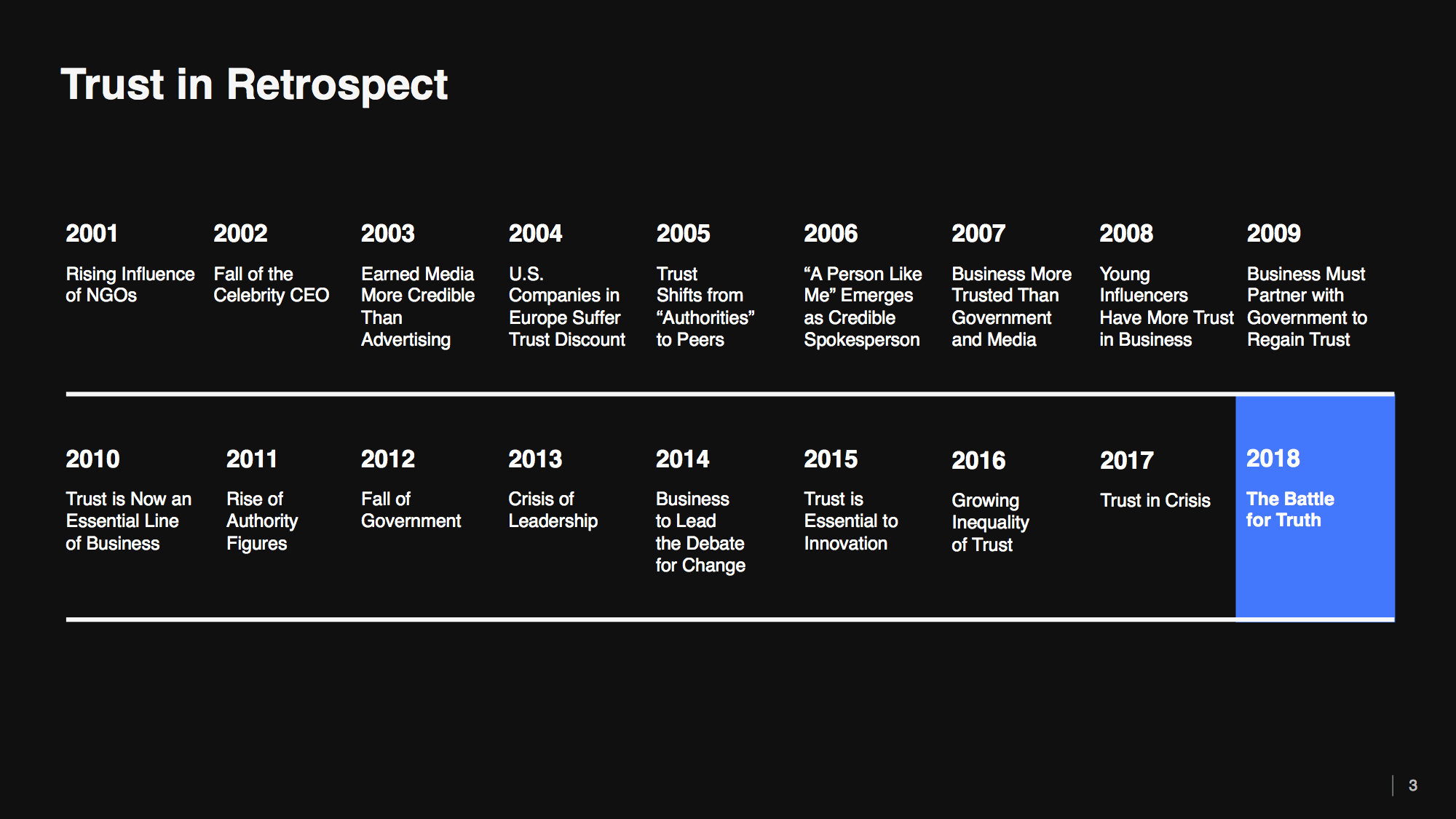
We really can’t say enough about trust. We’ve written about the trust economy, how brand purpose drives trust, the need for trust with your employees — and there’s a good reason we tackle this topic from so many angles. While trust will always remain supreme, the way people define it is always changing. Just take a look at this timeline from the Edelman report.

Establishing long-lasting trust can feel like trying to hit a moving target. As we parse through the statistics, here are some insights and implications for today’s CEOs.

Insight: 56% of people believe that companies that only think about themselves and their profits are bound to fail.

Implication: Your company doesn’t have to be an NGO to think outside itself. Providing transparency in the supply chain, supporting worthy causes, and demonstrating diversity and gender equality in the workplace are all ways of elevating a brand’s trust.

Insight: 60% of people believe that most CEOs are driven more by greed than a desire to make a positive difference in the world.

Implication: You must have a clearly articulated purpose. Here’s the thing about core values: they will still be there if the market shifts or customer preferences change. Hence, brand purpose becomes the anchor that keeps the ship afloat, even as the seas churn.

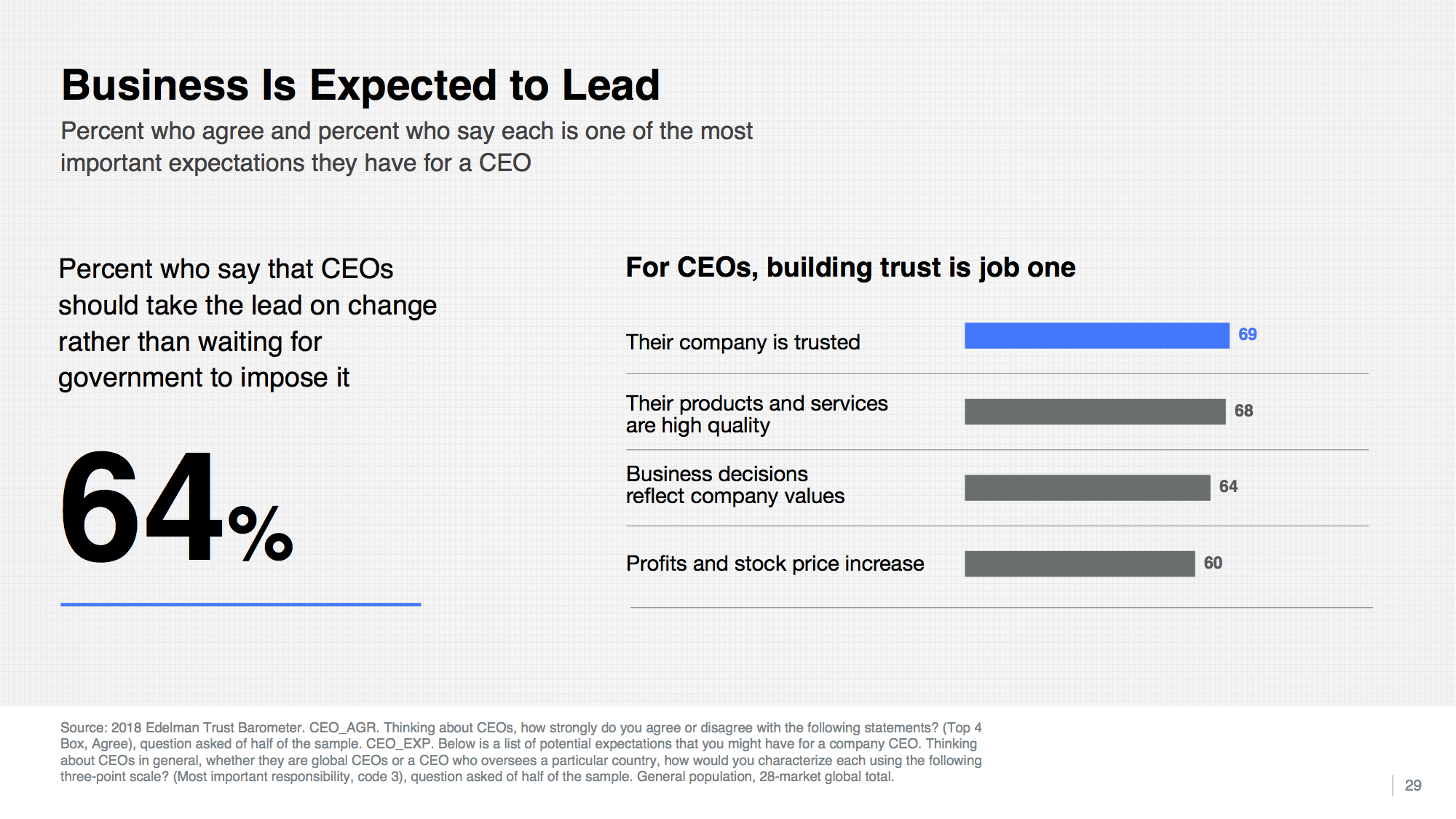
Insight: 64% of people believe that CEOs should take the lead on change rather than waiting for the government to impose it.

Implication: To employ some bumper sticker logic, be the change you want to see in the marketplace. Warby Parker didn’t wait for customers to get better healthcare, they responded with the Buy a Pair, Give a Pair program to give people the gift of sight.

In the battle for trust, the truth is not self-evident — but CEOs have the opportunity to make it so.

Emotive Brand is a brand strategy and design agency in San Francisco.

Need to Scale Fast? CEOs Can’t Just Focus On Engineering Benefits

Scale Fast to Beat The Competition

Why do so many engineering-led CEOs have a hard time scaling their company? I’d estimate more than 90% of our clients are engineers first and become CEOs later. An engineering background is of great value today – inspired ideas, technical abilities, and intense drive bring great products into the world.

Unfortunately, the problem is that many of these products fail to scale fast, and dreams of  becoming the next unicorn are quickly squashed. Sadly, when this happens, the world doesn’t derive the benefits of the product the team has worked so hard to bring to market.

In today’s fast-paced market, having a strategy to scale fast is a key to staying ahead of the competition. And trust me, there is lots of competition. I’ve seen a lot of situations where suddenly a competitor figures out how to both mimic the technology and to bring it to market in a way that scales fast. The first-at-the-gate CEO is left baffled – wondering what these usurpers did right in order to scale fast and win the market.

It Matters Where Your Promise is Rooted

The difference between failing and succeeding often comes down to the promise that surrounds the product. Traditionally, it was enough to root that promise in the engineering behind the products – focusing on the technical benefits and features. But now, more and more products are scaling fast and taking hold of the market by basing their promises outside the realm of engineering.

Why Promise More Than Good Engineering?

It is no doubt very hard to accept that, in today’s world, the most “obvious” story isn’t always the “right” story to tell. What may be obvious to an engineer leading a company, is rarely as obvious, relevant, and compelling to your audience.

As more and more successful brands are realizing, the best stories don’t revolve around the engineering “outputs” of your efforts but rather the personal, social, and environmental “outcomes” they produce.

Quite simply, the most compelling outcomes are those that touch the core human needs of everyone, and which incorporate whatever positive impact your brand has on the society, people, or even the environment.

Searching for Meaningful Outcomes

To develop an outcome-driven promise that really changes the way people think, feel, and act, you need to see your product through the lens of true and meaningful outcomes.

As such, you need to interrogate your product to uncover how it can make people feel more positive, more connected, accepted, capable, and competent. Accounting for all the positive, human contributions that flow from your product and brand, help shape emotional outcomes that act like magnets – drawing people into your brand, filling them with desire for your product, and ultimately, leading them down the path to purchase.

Outcome-Based Promises Help Products Scale Fast

Outcome-based promises have great power because they resonate deeply on an emotional level that lies well below the surface. By addressing basic human needs and desires, they register internally in very significant ways. While people may not readily talk about these transformative experiences, they nonetheless are influenced by them in ways that lead to new ways of perceiving your brand and acting in its interests.

Suddenly, There’s a New Light Shining on Your Engineering

People drawn to a brand through deep meaning develop an appetite for information that validates and supports their decision to embrace the brand. It’s part of human nature. Because of this, when people are emotionally connected to your brand, they are primed to appreciate your engineering story too.

They may well have turned away if you had started with your engineering-based promise of solely features and benefits, but now, they now stick by you as they recognize your features within the broader context of your meaningful product story.

Develop your brand story on truly meaningful outcomes to engineer success, scale faster, and grow smarter.

Emotive Brand is a startup brand strategy firm.

Leading a Digital Transformation: The Requirements of Today

The Strength of Digital Today

Across the globe, digital innovations are disrupting industries at lightning speed. And brands who want to be positioned to thrive, need to move fast enough to stay ahead. As a result, businesses leading digital transformations today are digitally innovating, digitally connecting, and digitally disrupting at record paces.

Moving Digital Forward

Accelerating into the future at this speed and competing in a landscape where every touchpoint is interconnected is hard work. Many CEOs are under a lot of pressure to locate and install the right technology as fast as they can get the funds to do it. And it’s difficult to know where to prioritize time and money.

While some companies have engaged people who are uncovering digital insights, fueling innovation, and leveraging deep data, other companies are falling behind because their leadership isn’t driving the march and leading decision-making. Companies who want to lead a digital transformation right now need strong leadership, agility, and a forward-looking vision.

Digital Transformation Today Requires:

1. Strong Leadership  

Being a digital leader no longer means simply being technologically savvy. Technological prowess is required, but it’s more than that. Driving a digital transformation means you have to be willing to take the driver’s seat in moving a clear, digital vision forward.

Many companies are carefully monitoring digital threats and opportunities. But the real challenge is using data and insights quick enough to stop these threats in their tracks. Without a clear vision from top leadership, this is impossible.

Putting digital first and gaining a deep understanding of the role digital plays in your business is a key part of being a successful leader today. If the future you envision doesn’t involve digital, it’s simply not a future. Leaders who are prioritizing digital innovations that work in line with their business’s core purpose are outperforming the competition.

2. Room to Innovate

Brands and businesses that are leading digital transformations today all show a commitment to constant testing, learning, and iteration. Many companies have even created unique spaces – innovation labs of sorts – to fuel digital innovation into the future.

Progressive, one of the U.S.’s largest auto insurers, created an Innovation Garage equipped with VR, interactive data screens, and the latest visualization tools. Progressive’s CEO believes that the Garage allows for agile, low-cost idea testing. People can move with speed and really focus, which adds energy to their work, and the space empowers people to imagine, experiment, and innovate.

The Innovation Garage lead to Progressive’s latest mobile app (Snapshot) that Progressive users or potential customers can opt into. The app gathers data from drivers’ smartphones and determines whether they qualify for an insurance discount based on their driving behaviors. This innovation allows Progressive to gather even more valuable data and offer increased value to their consumers. CVS also opened a similar digital innovation lab in Massachusetts that is focused on creating digital tools that will change the way healthcare is delivered.

3. Stay Super Connected

In the digital world today, timing is everything. And having the right timing requires staying deeply informed about what’s happening around you. Since everything is so connected, companies are widening their lenses for what to look for, both inside and outside their own business.

Esri, a mapping technology company founded in 1969 when the digital landscape didn’t even exist, believes digital mapping is one of the best ways to see and leverage connections. And not just in 2D. Digital maps are becoming 3D. They have story and texture. It’s all about relationships, says the CEO: “what’s near what, what’s on top of what, what drives success.” This kind of mapping helps businesses stay responsive in shifting times.

And Esri isn’t alone in this belief. Lots of thriving companies today are using maps and spatial analysis to discover digital insights, makes connections, and fuel digital innovation. UPS is using spatial analysis to increase efficiency and cost savings. Starbucks is using GIS to do site selection with machine learning. Shell Oil is also using maps to do analytics.

Staying uber-connected also means more collaboration and more partnerships. The more companies that connect themselves with other big companies and small startups, the more pull they have. CVS is piloting a partnership with Uber in SF – leveraging Uber’s capabilities to increase pharmacy convenience. Keeping up with what other digital innovations mean to your business is also key to staying connected and pushing boundaries today.

Getting Everyone On Board

Digital transformations mean change – fast moves, big shake-ups, different status quos, shifting role. But for many, even those on the cutting edge of digital innovation, change can be hard. Many companies that are driving digital transformation overlook the challenge of getting everyone on board. So it’s important to remember that even the strongest digital strategy will fail if your people are not willing to embrace it.

Embedding adaptability, flexibility, and innovation into your culture can help make the shift to digital easier. People who are equipped to handle an ever-shifting status quo, who don’t settle for the now, and who are always looking toward the future are the people who you need to lead your digital change. Build a company culture that embraces digital for all that it is – unsteady, ever-changing, prolific, powerful, limitless. Then you will be able to take any digital transformation head on.

Emotive Brand is a San Francisco brand strategy and design agency.


Purpose-led Brands and the Role of the CEO

Purpose-led leaders lead thriving businesses.

If you are a marketer faced with the task of re-branding or leading a brand strategy for your business, think about the person most influential to its success. Wondering who is essential to be part of the team? Ask yourself:

  • Who has the greatest insight into where your business needs to go?
  • Who can make sure that the company’s brand strategy embodies, and brings to life, this vision?
  • Who sees how the people, processes and policies of the business need to evolve to address future issues and opportunities?
  • Who is the best person to lead the organization forward in a focused, unified and purposeful manner?
  • Who do you need to ensure is on the team and willing to lead this project by your side?

The CEO

Yet, how many CEOs play a vital role in the development of brand strategy – that is, to the point where they achieve real feeling of ownership of the strategy’s ambition? Going further, what does this mean to the successful deployment  and socialization of the brand strategy across the business?

Unfortunately, all too often, branding is seen as a subset of the business, a line-item in the overall business strategy, and the responsibility of a team (and their agency) reporting to the CMO.

In many cases, the resulting “brand book” invariably features an introduction from the CEO, in which there are a series of predictable, jargon-filled and corporately-safe comments. It may have the signature of the CEO below it, but few honestly believe the CEO has written, or even read, this letter.

Delegated activity, not a transformative business strategy

Indeed, for the CEO, the “brand” often is a mystery and something better left to others. It is something to be delegated and not to be owned. As such, to the CEO it is more of activity resulting in a document, than a key element of a transformative business strategy.

This state of affairs leaves any brand strategy, however meaningful, out on a limb. While the brand team will be passionate advocates of the strategy, everyone else in the company will, like the CEO, think of the brand as “someone else’s job”.

And this, sadly, is where many brand strategies crumble to pieces.

  • A brand strategy becomes a new logo and guidelines.
  • A strong brand promise is created, but it is not clear what it means or why it matters.
  • The brand strategy, while the right one, lives in a file cabinet drawer, or on the wall as a poster.
  • Or worse yet, a brand strategy is developed, yet never fulfilled on.

The brand strategy fails because it was neither truly “top-down” (it came from another “department”, not from the big honcho), nor “bottom-up” (because employees beyond the brand team didn’t see it as their job to do).

The value of CEO ownership

When a CEO is urged, encouraged and, if need be, prodded to take a lead in the brand strategy process, a different result is experienced. It’s not at all that the CEO develops or writes the strategy. Rather, the CEO comes to see how his or her vision is embodied in the brand strategy, and how it can be used as a tool to transform the organization so that it can be stronger today, and better fit for the future.

When a CEO is seen as the chief proponent of, and supporting voice for, the strategy, employees throughout the organization see the strategy as more core to the business, and what they do within that business. They pay attention to strategy (assuming its delivered to them in a personally relevant and emotionally important way) and absorb it’s intent into their work practices (again, assuming they are shown how to do just that).

The value of across-the-board brand activation

Truly purpose-led brands stand out because they not only enjoy top-down support starting at the CEO, but because the brand strategy doesn’t stop at communications to the external world.

In this bottom-up mode, purpose-led brands take an holistic role in transforming how the brand is experienced, both inside and outside the business. No one in the business is left behind, as the brand strategy is deployed and socialized in a way that makes it the company’s “way of being”. Where employees are taught what it means to “Live the brand” each and every day.

When they feel purpose-driven, focused and gratified, employees work individually and in teams to create an energy that attracts the best customers, the most talented recruits, the most potent partners and the right investors. And your business thrives.

Top-down, bottom-up brand purpose-led strategies for better results overall

Brand strategies that embrace this “top-down, bottom-up” thinking aren’t relegated to the sidelines by the organization. Rather, as CEO-empowered forces, the relevant ambitions of the strategy become ideas which shape employee attitudes and behavior across the business.

Being based in the CEO’s vision, these purpose-led brand strategies work harder to point the business in the right direction, move it ahead with greater speed and agility, and lift it to a higher, more meaningful level in the hearts and minds of people.

Interested in learning more about a purpose-led brand strategy? Curious how to transform your business with a brand strategy? Download our white paper below.

Download White Paper

Emotive Brand works with CEO”s to help create purpose-led brand strategies that transform business.

The CEO Challenge – Turning Corporate Vision Into Reality

The corporate vision statement

We’ve written before about the gaps between what business leaders believe and what their employees think when it comes to the company’s corporate vision and values.

Today we’d like to explore another gap. This is the gap between what the CEO sees as the company’s vision, and what employees are doing to help achieve that vision – often referred to as the Corporate Vision Statement.

In some cases, the gap exists simply because employees haven’t been informed of the vision.

As such, they are left to their own devices, pulling the company and its brand strategy apart because they don’t know how or why they’re meant to keep it together.

In other cases, the gap exists because the vision was delivered to the employees in a way that left them feeling less than enthusiastic.

Delivered in an alienating “corporate” way and not in a meaningful “human” way.

It therefore did not enchant, inspire or engage the employees.

It simply did not matter to them.

It literally “went in one ear and out the other”.

We help our clients turn their vision into a meaningful reality.

We get corporate visions to matter to employees, and employees align to the vision.

We do this by translating the “corporate vision” into a credible and meaningful “human ambition”.

We make the vision both personally relevant and emotionally important to employees.

They come away not only with a clear idea of what they need to do, but also with a profound sense of why they should help the company achieve its vision.

As result they are motivated to propel the company and its brand to a more meaningful position in the world – a position defined by the CEO’s vision and tempered by an understanding of what it takes to get people to care in today’s world.

Have you been involved in any programs where this has been executed well? If so, we’d love to help.

If you have a “corporate vision” that has not yet been articulated into a meaningful brand narrative that employees can rally around and believe in, let us know. We can help!

You might enjoy reading more about our ideas around Brand Promise by visiting our blog.

We are launching a new solution entitled “Path to Purpose”. This is a 6-week program that was developed for senior leadership teams to get aligned around the value of a corporate purpose statement, how to articulate it, what it means to your business, and how it can align your entire organization around it meaningfully. If you are interested in learning more please contact Co-Founder, Tracy Lloyd.

Emotive Brand is a San Francisco brand strategy firm.